

Views: 0 Author: Site Editor Publish Time: 2026-10-23 Origin: Site


Investing in a heavy-duty earthmoving machine dictates your site operational rhythm and financial health. Are you managing a large-scale quarry or extracting valuable minerals? The right machinery drastically reduces your cost per ton and skyrockets site productivity. Choosing the perfect Mining Crawler Excavator requires moving beyond basic marketing brochures. You need to scrutinize engine power, bucket capacities, and hydraulic flow from an engineering perspective. This guide strips away the fluff. We will walk you through essential specifications, undercarriage durability, and total cost of ownership to ensure a bottom-line-boosting purchase.
Look at any modern quarry operation today. The massive 100-ton behemoths are slowly stepping back. Site managers face strict emission caps and shrinking fuel budgets. Consequently, the industry is actively shifting toward the 50-ton class. This weight segment offers the perfect synergy of economic viability and raw productivity. A modern 50-ton machine equipped with advanced hydraulics delivers massive breakout force without the logistical nightmares of transporting ultra-class units. It is the ultimate tool for adapting to volatile market demands while maintaining high daily extraction targets.
Beyond overarching industry trends, true equipment value lies in technical specifications. As frontline engineers, we look directly at the raw numbers. Let us break down the non-negotiable parameters for your next investment.
Stability is everything on a jagged quarry floor. An operating weight hovering close to 50 tons provides a massive counterweight. Specifically, a precise 49.7-ton operating weight ensures an incredibly low center of gravity. When an operator swings a fully loaded bucket over uneven terrain, this substantial mass prevents tipping. It directly translates to enhanced lifting capacity and unwavering digging stability on unpredictable ground.
Powering through compacted shale requires a high-torque engine that refuses to stall under sudden load spikes. Look for a robust power output of exactly 343kW. This specific horsepower rating guarantees continuous operation. It provides the necessary muscle to tackle stubborn geological formations day in and day out without engine fatigue.
Matching bucket volume with material density is a precise science. A 2.8 to 3.2 cubic meter bucket capacity is the absolute sweet spot for a 50-ton unit. This volume allows for optimal pass-matching with standard articulated haul trucks. You avoid wasting time with under-filled loads. In addition, you prevent the severe hydraulic strain caused by oversized buckets.
Understanding where the 50-ton machine sits in the wider market helps validate your investment. The following comparison highlights why this specific weight class dominates modern extraction sites.
Feature | 30-Ton Class | 50-Ton Class | 80-Ton Plus Class |
|---|---|---|---|
Mobility and Logistics | Excellent | High | Poor |
Typical Bucket Capacity | 1.3 to 1.6 cubic meters | 2.8 to 3.2 cubic meters | 4.5 cubic meters and above |
Engine Power | 150kW to 200kW | Approximately 343kW | 350kW and above |
Best Application | Trenching and light construction | Heavy mining and large quarries | Massive open-pit mining |
The engine generates the raw power, but the hydraulic system is the beating heart. Its fluid efficiency dictates your actual earthmoving speed on the ground.
Bucket and arm breakout force define the ability to pry material loose. High ratings are absolutely vital when handling abrasive, interlocked blasted granite. Furthermore, maximizing digging depth minimizes the need to constantly reposition the machine. Fewer track movements translate to faster extraction rates and significantly lower undercarriage wear.
Speed equals profit in earthmoving. Advanced hydraulic pumps and smart flow distribution lead to faster cycle times across the dig, swing, dump, and return phases. Heavy-duty extraction requires relentless continuous operations. Therefore, integrated heavy-duty hydraulic cooling systems are mandatory. They prevent overheating and maintain fluid viscosity under extreme stress.
Moving down to the foundation, the undercarriage demands rigorous inspection. Track and chassis repairs historically represent the highest maintenance costs over a machine lifespan.
Selecting the right track shoe width is essential for adapting to your specific environment. A well-engineered Heavy-Duty Mining Crawler Excavator distributes its massive 49.7-ton weight evenly. Optimal ground pressure prevents sinking into soft earth while maintaining aggressive traction on steep, rocky inclines.
Standard construction equipment will not survive a quarry. Reinforced booms, arms, and bucket linkages are critical. Look for heavy-duty bottom rollers, full-length track guards, and a robust X-frame chassis. In contrast to standard frames, these components are specifically designed to absorb severe torsional stresses during heavy extraction tasks.
Stop looking at abstract features. Use these direct, frontline criteria to choose your next piece of equipment.
Assess Your Material Density: Are you moving loose dirt or blasted rock? For high-density rock, prioritize reinforced rock buckets and maximum breakout force. Ensure the bucket capacity stays strictly within the 2.8 to 3.2 cubic meter range to avoid overloading the boom cylinders.
Evaluate Operator Environment: A comfortable operator is a highly productive operator. Demand multi-adjustable air suspension seats and automatic climate control. Roll-Over Protective Structures and Falling Object Protective Structures are non-negotiable safety standards. Furthermore, 360-degree camera systems eliminate blind spots in busy pit environments.
Calculate Total Cost of Ownership: Do not just look at the sticker price. Calculate fuel burn rates. An engine delivering 343kW must feature smart auto-idle and eco-modes to slash hourly fuel costs. Check for ground-level service points. Centralized lubrication systems keep the machine in the dirt and out of the maintenance bay.
When aligning these rigorous engineering criteria, certain models naturally rise to the top. They perfectly match the brutal demands of modern extraction sites.
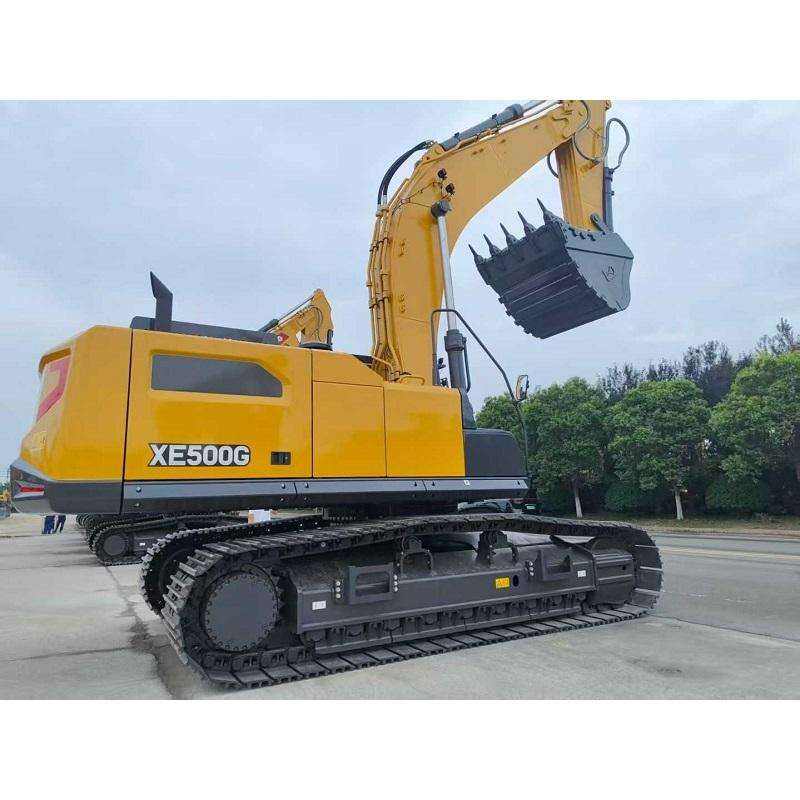
The XE500G High-Efficiency Construction Mining Crawler Excavator hits the exact specifications required for peak performance. It boasts a highly stable 49.7-ton operating weight and a formidable 343kW engine. The versatile 2.8 to 3.2 cubic meter bucket capacity is flawlessly tailored for continuous heavy material handling.
This model masterfully combines reinforced durability with cutting-edge fuel efficiency. It delivers maximum tons-per-hour while keeping operational overhead remarkably low. Ready to upgrade your fleet and drastically reduce your cost per ton? Evaluate your site conditions, calculate your true total cost of ownership, and explore the full specifications of the XE500G. Visit Xuzhou Shangheng today to secure the exact heavy-duty machinery that will decisively drive your business forward.
Most 50-ton heavy-duty models offer a maximum digging depth ranging from 6.5 to 7.5 meters, depending on the specific boom and arm configuration. This depth is highly effective for bench loading and deep trench extraction in quarry environments.
Moving a machine of this size requires a specialized heavy-haul lowboy trailer. Due to the massive 49.7-ton operating weight and wide track gauge, transport often requires special oversize load permits and escort vehicles depending on local highway regulations.
For most heavy-duty mining and quarrying tasks, a bucket capacity between 2.8 and 3.2 cubic meters offers the best balance of volume and digging force. This size allows for rapid truck loading without overloading the hydraulic system or compromising cycle times.
Fuel consumption varies based on work intensity and material density. However, modern 50-ton models equipped with 343kW engines utilize smart hydraulic flow distribution and eco-modes to keep fuel consumption highly competitive, significantly reducing hourly operating costs.
Tracked machines provide vastly superior traction, stability, and lower ground pressure on uneven terrain. Wheeled units simply cannot navigate the jagged, unpredictable floors of a quarry safely, making crawlers the mandatory choice for heavy-duty extraction.
With rigorous preventative maintenance and high-quality fluids, a premium 50-ton machine can easily surpass 10,000 to 15,000 operating hours before requiring a major engine or hydraulic overhaul. Consistent undercarriage care is the key to reaching this longevity.
Heavy-duty models are structurally distinct from standard construction equipment. They feature heavily reinforced booms, thicker steel plating on the undercarriage, enhanced hydraulic cooling systems, and rock-specific buckets designed specifically to withstand constant abrasion and extreme impact forces.


